Nine trades,
one site team.
We only work for professionals in the play and sports equipment industry. Here is what we take on, and how.
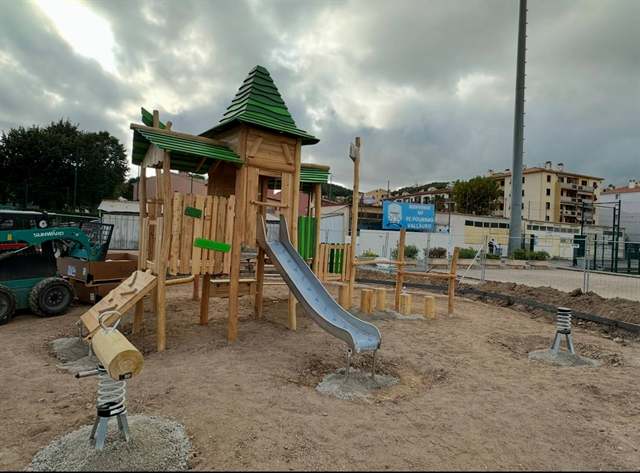
Playground installation
Assembling play equipment is not just bolting parts together. Foundation depth, post plumb, safety distances and free fall height determine whether the whole installation is compliant.
- Setting out from the manufacturer's drawing, checked against the real site
- Concrete foundations sized to each equipment data sheet
- Plumb and level checked at every post before pouring
- Torque settings and thread locking to specification
- Safety zones marked out and verified before handover
EN 1177 impact-attenuating surfacing
Thickness is not a matter of opinion. It follows from the free fall height of the tallest piece of equipment in the zone — and it must be HIC-certified for that height.
| Free fall height | Wet pour thickness | Typical use |
|---|---|---|
| up to 600 mm | 10 mm | Spring riders, ground-level trails |
| 600 – 1,100 mm | 20 – 30 mm | Toddler units |
| 1,100 – 1,500 mm | 40 – 50 mm | Standard multi-play |
| 1,500 – 1,800 mm | 60 – 70 mm | Swings, 6-12 structures |
| 1,800 – 2,200 mm | 80 – 100 mm | Towers, rope nets |
| 2,200 – 3,000 mm | 110 – 160 mm | Tall climbing structures |
Above 3,000 mm free fall height the chart no longer applies: an HIC test or a case-by-case study is required. Our online calculator reproduces this chart for seven materials — the interface is in French, but the figures speak for themselves.
Wet pour rubber
SBR base layer plus EPDM wear course, poured seamlessly on site. Logos, patterns and two-tone designs made to template while the resin is still open.
Tiles & synthetic grass
Rubber tiles laid on a drained, laser-levelled sub-base; synthetic grass over a certified shockpad. Only the product's own HIC certificate is binding.
Loose fill
Bark, wood chips, washed sand, rounded gravel. EN 1177 depths plus 100 mm displacement allowance — so 300 mm laid for a 200 mm nominal depth.
Groundworks & the rest of the site
The most common and most expensive situation on a playground project: the equipment is delivered, the crew is on site, and the ground was never prepared.
Excavation & sub-base
Dig to working depth, spoil removal, compacted granular sub-base, geotextile and laser levelling. Platform flatness directly controls the real surfacing thickness.
Drainage & edging
Land drains on clay or low-lying sites. Concrete, recycled plastic or timber edging — loose fill without edge restraint spreads within two seasons.
Sports courts
Multi-use games areas, ball-stop fencing, sports surfacing and line marking. Beach volleyball and padel included — see the Antibes project.
Outdoor fitness
Fitness equipment falls under EN 16630, not EN 1176: different clearance zones, adult loadings, heavier foundations.
Street furniture
Benches, litter bins, planters, shelters, cycle stands and fencing. Batch installations across several municipalities, organised as a single round.
Refurbishment & inspection
Worn surfacing renewed without removing the equipment, annual main inspections and bringing existing sites back into compliance.
Send the drawings. We price within 48 hours.
Layout drawing, equipment data sheets, target date. Even an incomplete file is enough for us to say yes or no quickly.